The course · Undertone · Lesson 6 of 6 · 20 min
Iris chroma sets how strong an eye color can be
After this lesson you can say how strong an iris color is on a six-point chroma step. You can also say why the lightness is held in the figure and why a bright-looking eye still gets a drape check.
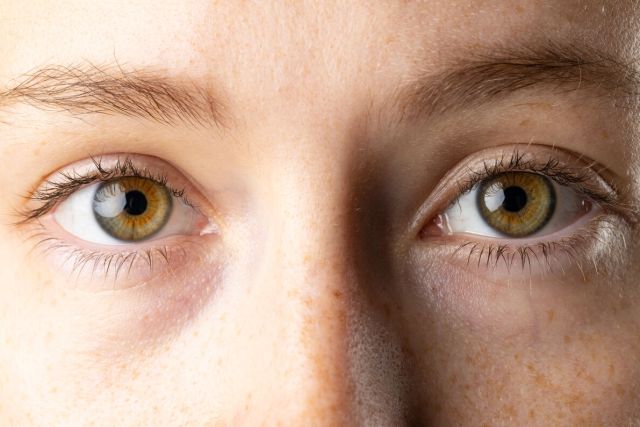
Her blue eyes look quiet in one photo and strong in another, though their hue and lightness are the same.
A client with blue eyes sends two photos of the same iris. The hue and the lightness read the same in both. In the first, the eyes look quiet beside her face. In the second, they look strong and start to compete with it. The one thing that moved is the strength of the color.
Iris chroma is how strong the color of the iris is.
The iris is small, bright and close to the face. A high-chroma iris can compete with the face, and a lower one leaves the face in front. Chroma is the strength of a color, apart from its hue and its lightness.
Eye color has no single rule behind it, so each eye is read as it appears.
Iris color comes from pigment in the iris, and several genes contribute to it. A study of 5,641 people of European ancestry found the strongest effects in the HERC2 and OCA2 region and signals elsewhere too. No single rule predicts an eye color, so ancestry is not used to guess one.
Iris color can be measured from controlled images, but no table sets the numbers for a named color.
One recent study reports a CIELAB-derived metric from 91 eyes under controlled dark lighting. Its sample is restricted. The sources reviewed give no fixed Lab ranges for named eye colors, so no table sets a blue or a brown. Each iris is measured.
The iris chroma scale centers on 20, and each step of 6 is one step of strength.
In the figure, a blue iris at hue 250 and lightness 55 has its chroma stepped from 8 to 32. Chroma 20 is the center. Chroma 14 is one step below it and chroma 26 is one step above. Lightness is held at 55 because the sources give no iris lightness range.
Apparent brightness can mislead, so a bright-looking eye is checked in the drape.
The authors of an iris study suggest that iris color could make the front of the eye look brighter or darker, which could bias measurements. Apparent brightness depends on pigment. A client whose eyes look bright in a photo is checked against her face in the drape before any color is named.
The method gives iris chroma a weight of 0.2 in clarity, and the drape confirms it.
The iris is read from a wedge at 9 and 3 o'clock. Its step count is (chroma minus 20) divided by 6. A chroma of 29 is 1.5 steps above center and adds 0.3 to clarity at a weight of 0.2. That is a small part of the reading, and the drape decides the color.
Figure
A blue iris at hue 250 and lightness 55, the value center, with chroma stepped from 8 to 32 in steps of 6. Chroma 20 is the center. Lightness is held because the sources give no iris lightness range. This is a drawn illustration of the steps, not a measured eye. In grays all five squares look alike; in color the strength rises from left to right.
In their words
“To evaluate whether iris color contributes to variability in CD estimates, an objective and reproducible metric of iris pigmentation is required.”
Arizcuren AR, Consejo A, Influence of iris color on corneal densitometry, Journal of Optometry
Check
The same blue iris looks quiet in one photo and strong in the other. What moved?
Show the answer
A. The strength of the color
Hue and lightness read the same in both photos. The strength, which is the chroma, is what moved.
Practice
Photo 1 shows an iris at chroma 14 and photo 2 shows the same iris at chroma 26, with hue and lightness equal. Which statement is correct?
Show the answer
A. Photo 2 shows the stronger eye, two steps above photo 1
Chroma is the dimension that differs, with hue and lightness held equal. 26 minus 14 is 12, which is two steps of 6, and the higher chroma is the stronger color. Equal hue does not make equal strength.
Client A's iris reads chroma 20 and client B's reads chroma 32. How far apart are they, and which is stronger?
Show the answer
A. Two steps apart, and B is stronger
32 minus 20 is 12, which is two steps of 6. Higher chroma is the stronger color, so B. Chroma 20 is the center of the scale, and it still sits two steps from 32.
A client's eyes look bright in her photo, so a trainee names a vivid color for her at once. What do you do first?
Show the answer
B. Check her face against the drape, since brightness can mislead
Apparent brightness depends on pigment and can bias a reading. So a bright-looking eye is checked against the face in the drape before a color is named. A photo alone does not settle it.
In the iris figure, what is held fixed, and why?
Show the answer
C. Lightness at 55, since the sources give no iris lightness range
The sources reviewed give no iris lightness range, so the lesson holds lightness at the value center, 55, and changes only the chroma. A real eye still needs its own lightness reading.
A trainee says a client's eye color should be named from her ancestry. What is the sound reply?
Show the answer
A. No, since many genes decide it, read the eye as it appears
Eye color depends on several loci, with strong effects at HERC2 and OCA2 in some populations, and no single rule predicts it. Observed appearance is used instead of ancestry.
A client's iris reads chroma 14. Where does that sit on the scale?
Show the answer
D. One step below the center of 20
14 minus 20 is minus 6, which is one step below the center. Each step on the scale is 6 chroma. Two steps would be 12 below, which is chroma 8.
Case study 6
Sofia has blue eyes, and her iris reads hue 250, lightness 55 and chroma 29 in a corrected photo. A stylist says her eyes are a strong feature.
Give her iris chroma as a step count, say what it adds to the clarity reading, and say what you confirm.
Show the worked answer
Step 1: count from the center, 29 minus 20 is 9, and 9 divided by 6 is 1.5 steps above center. Step 2: a strong feature fits, since a high-chroma iris can compete with the face. Step 3: at a weight of 0.2, 1.5 steps adds 0.3 to clarity. Step 4: lightness is held at 55, so confirm the color against her face in the drape.